

Last Updated: November 7, 2026
Quick Summary
The best coffee blends for a drip maker are ground evenly to a medium consistency, roasted at a medium level that survives a longer brew cycle without turning bitter, and sold fresh. Match the grind and dose to your brewer rather than buying an espresso blend, which can taste harsh and flat in a drip machine.
- Nightfall Blend, Moonshadow Blend, Midnight Blend, First Light Blend and Dead of Night Blend are all priced at $18.00 per bag.
- Smooth Coffee is a medium-roast ground option with a mellow flavor that works black or with milk.
- Start with 15 g of coffee per 250 ml of filtered water heated to 195-205°F (90-96°C).
- A flat-bottom basket with a permanent metal filter needs a slightly coarser medium grind than a cone basket with paper.
- Eclipse Roast and Midnight Roast are ground options priced at $15.00 for budget-friendly everyday brewing.
Table of Contents
- What Makes a Coffee Blend Right for a Drip Coffee Maker
- Coffee Blends for Drip Brewers: A Quick Comparison
- The Best Ground Coffee for a Drip Machine
- Why Medium-Roast Coffee Beans Suit Drip Coffee
- Coffee Grind Size for a Drip Coffee Maker
- How to Keep Coffee Beans Fresh After the Bag Opens
- Match a Blend to Your Drip Routine and Order It
- Frequently Asked Questions
What Makes a Coffee Blend Right for a Drip Coffee Maker
A drip coffee maker rewards consistency. It heats water, sends it through a bed of grounds at a steady rate, and lets gravity do the rest. That predictable process changes what you should look for in coffee blends. Midnight Coffee offers freshly roasted blends, and the right one for your brewer depends on how you brew.
The right blend for a drip brewer has three traits. It is ground evenly, so water passes through at the same speed everywhere. It sits at a roast level that survives a longer brew cycle without turning bitter. And it is fresh, because stale grounds give up their aroma before the water ever reaches them.
A common mistake is buying a blend built for espresso and expecting it to shine in a drip brewer. Espresso blends are often roasted darker and ground finer to stand up to pressure. In a drip machine, that same coffee can taste harsh and flat. Match the grind and dose to your brewer, not the other way around.
If you want to go deeper on bean selection, our guide to drip coffee beans that make mornings better walks through roast and flavor choices for daily brewing.
Coffee Blends for Drip Brewers: A Quick Comparison
Every blend below is built for the drip brewer, but they suit different drinkers. Prices are per bag.
| Blend | Price | Form | Best For |
|---|---|---|---|
| Nightfall Blend | $18.00 | Whole bean or ground | Cocoa-forward everyday cup |
| Moonshadow Blend | $18.00 | Whole bean or ground | Sharing and breakfast brewing |
| Midnight Blend | $18.00 | Ground | Smooth, comforting daily coffee |
| First Light Blend | $18.00 | Whole bean or ground | Gifting and coastal-inspired routines |
| Dead of Night Blend | $18.00 | Whole bean or ground | Quiet morning or afternoon breaks |
| Smooth Coffee | $20.00 | Ground, medium roast | Mellow, easy-drinking cups |
| Holiday Coffee Blend | $20.00 | Whole bean or ground, dark roast | Festive gatherings and cozy mornings |
| Last Light Decaf | $18.00 | Whole bean or ground | Late-day coffee without caffeine |
| Eclipse Roast | $15.00 | Ground | Budget-friendly everyday brewing |
| Midnight Roast | $15.00 | Ground | Simple, reliable morning coffee |
Price
Nightfall Blend has a savory cocoa profile and can be enjoyed black or with milk. Moonshadow Blend is the one to put on the table when guests arrive. If you want to browse the full range side by side, the blends collection has every option in one place.
Best for: anyone who wants a cocoa-toned daily cup. Skip if: you prefer a dark, roasty profile, where Holiday Coffee Blend fits better.
The Best Ground Coffee for a Drip Machine
The best ground coffee for a drip machine is ground to a medium consistency, sold fresh, and matched to your brewer's basket. Pre-ground coffee removes one variable from your morning, and for most drip owners that trade is worth it.
Ground coffee has one real weakness: it stales faster than whole bean because more surface area meets the air. Buy in amounts you will finish within a few weeks, and reseal the bag properly between brews. A common mistake is decanting grounds into a wide, open canister on the counter. That looks tidy and ruins the coffee.
Smooth Coffee is a medium-roast ground option with a mellow, smooth flavor and regular caffeine, and it can be enjoyed black or with milk. Eclipse Roast and Midnight Roast are ground options priced at $15.00.
Watch out: if your drip machine has a small flat basket rather than a cone filter, a very fine grind can clog it and slow the brew to a drip. Check the package for grind suitability before you commit to a large bag.
Why Medium-Roast Coffee Beans Suit Drip Coffee
Medium-roast coffee beans are a common choice for drip brewing. A medium roast sits between the bright, tea-like character of a light roast and the smoky weight of a dark one. In a drip brewer, that middle ground holds up best.
Dark roasts are not wrong, they are just less forgiving. The longer a dark roast sits in hot water, the more its bitter compounds dominate. If you love a dark profile, Holiday Coffee Blend is roasted dark and works well when you keep the brew cycle short and the dose honest.
Medium roast can be enjoyed with milk or a plant-based alternative. For a dedicated medium-roast option, our Medium Blend is the straightforward choice.
Best for: drinkers who want balance and sweetness. Skip if: you want a heavy, smoky cup, in which case go dark.
Coffee Grind Size for a Drip Coffee Maker
The correct grind size for a drip coffee maker is medium, roughly the texture of table salt. But "medium" is a range, not a single setting, and the right point inside that range depends on your brewer's basket and filter type.
Grind consistency matters as much as grind size. If half your grounds are powder and half are pebbles, water races through the coarse bits and stalls on the fine ones. The result is a cup that tastes both weak and bitter at once.
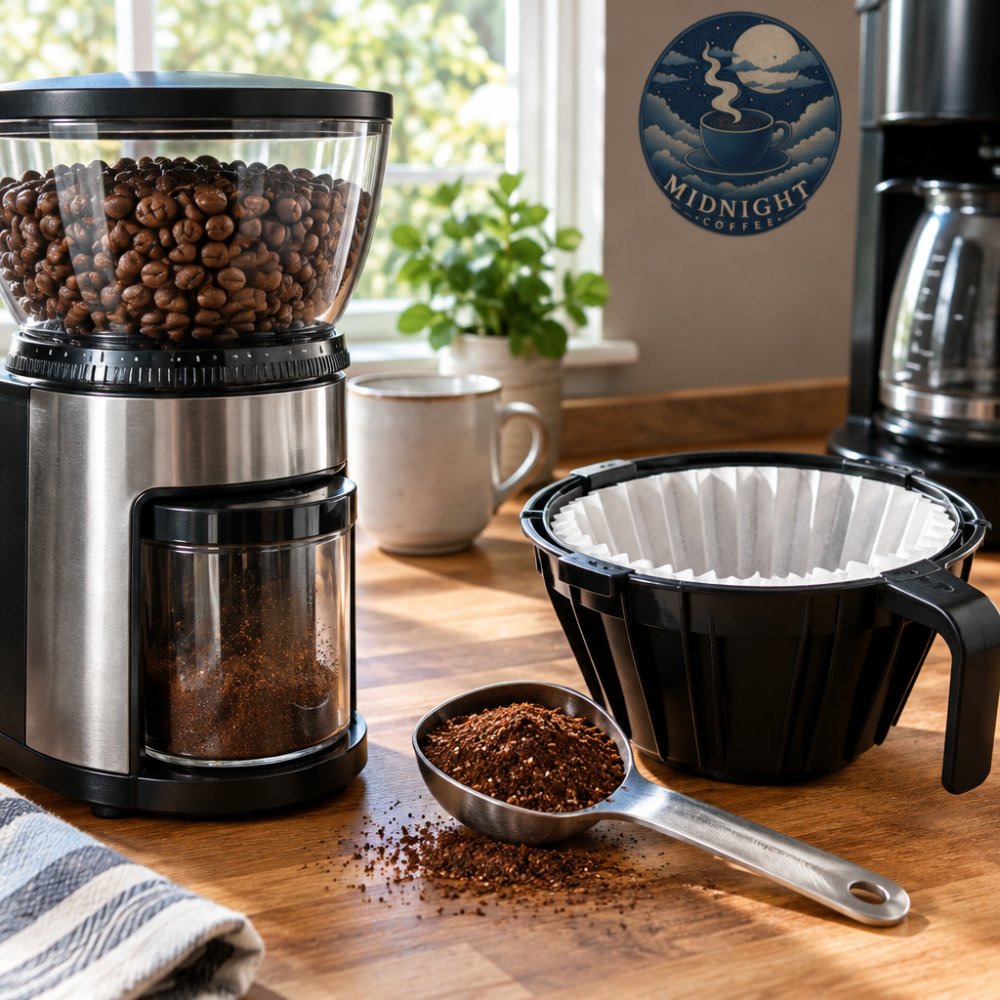
Match grind to your basket and filter. A cone-shaped basket with a paper filter tolerates a slightly finer medium grind because the paper slows water evenly. A flat-bottom basket with a permanent metal filter needs a slightly coarser medium grind so fine particles do not clog the mesh and slow the brew to a drip. If your machine uses a reusable metal filter, expect to grind one or two steps coarser than the package suggests.
Start with measurable numbers. A practical starting point is 15 g of coffee per 250 ml of filtered water, heated to 195-205°F (90-96°C). Adjust in small steps: if the cup tastes weak and sour, grind finer or add 1-2 g of coffee; if it tastes bitter and dry, grind coarser or reduce the dose slightly. Change one variable at a time so you can taste what worked.
Troubleshoot by taste, not by package instructions. Weak and sour usually means under-extraction: the grind is too coarse, the dose too low, or the brew cycle too short. Bitter and hollow usually means over-extraction: the grind is too fine, the dose too high, or the water too hot. A cup that is both weak and bitter at once points to inconsistent particle size, which is the blade grinder problem rather than a dose problem.
Adjust for brewer type. Standard drip brewers with a fixed showerhead and no strength setting reward a consistent medium grind and a level bed of grounds.
If you are coming from a French press, expect to grind noticeably finer. Coarse grounds that work in an immersion brewer will under-extract in a drip machine. If you are coming from espresso, expect to grind much coarser; espresso-fine grounds will clog a drip basket and stall the brew.
Watch out: a very fine grind in a small flat basket can clog the filter and slow the brew to a drip, which over-extracts the coffee and leaves a bitter cup. Check the package for grind suitability before you commit to a large bag.
How to Keep Coffee Beans Fresh After the Bag Opens
Freshness is the single biggest upgrade most drip drinkers can make, and it costs nothing. The compounds that give a blend its sweetness and fruitiness are volatile, which means they evaporate into the air rather than staying in the bean. Keep those three away and your blend stays bright for weeks.
Read the roast date, not the best-by date. A best-by date tells you when the bag is past its prime, not when it was roasted.
Store beans in an airtight container, in a cool dark cupboard. Keep them in the bag's original valve packaging or a sealed canister. The one-way valve on a good coffee bag lets CO2 escape without letting oxygen in, which is why the original bag often outperforms a decorative canister.
Buy whole bean when you can, and grind only what you will brew that day. Pre-ground coffee stales faster than whole bean because more surface area meets the air. For a drip brewer, the difference is noticeable within a week: whole-bean coffee ground just before brewing holds its aroma, while pre-ground coffee opens flat and finishes thin. Our detailed guide to keeping coffee beans fresh covers seven storage rules worth following.
Match bag size to your brewing pace. Buying a smaller bag more often beats a bulk bag that fades.
Watch the packaging format.
Unsure whether an open bag is still good? Our article on how to tell if coffee beans are fresh gives you a quick check before you brew a disappointing pot.
Watch out: buying a large bag to save per-ounce cost backfires if you cannot finish it in a few weeks. For most households, a smaller bag bought more often beats a bulk bag that fades.
Match a Blend to Your Drip Routine and Order It
Your routine should pick the blend, not the other way around. A student brewing one strong mug before a late study session wants something different from a household filling a carafe on a Sunday morning.
Here is how we would match it:
- Early mornings, full pot: Smooth Coffee or Midnight Blend, which are both listed as easy-drinking everyday brews.
- Late-night work: a regular-caffeine blend like Nightfall Blend, or Last Light Decaf if you want the ritual without the lift.
- Guests and breakfast: Moonshadow Blend, built for sharing.
- Budget brewing: Eclipse Roast or Midnight Roast at $15.00.
Midnight Coffee offers freshly roasted, ethically sourced products, with free delivery listed as a key feature. Subscription Plans are available if you want regular deliveries. If you are tired of grocery-store coffee that tastes flat by midweek, the fix is simpler than you think: fresher beans, a medium grind, and a blend built for your brewer. Get started with Midnight Coffee and taste the difference fresh roasting makes in your next pot.
Frequently Asked Questions
What is the best coffee to use in a drip coffee maker?
A medium grind is listed for drip and pour-over brewing across Midnight Coffee's blends. Whole bean coffee ground just before brewing keeps more aroma than pre-ground. Midnight Coffee's Nightfall Blend, with its cocoa profile, and Smooth Coffee, a mellow medium roast, both list a medium grind for drip brewing. Use about 15 g of coffee per 250 ml of filtered water at 90-96°C and adjust to taste.
Is medium-roast coffee best for drip machines?
If you prefer a bolder cup, a dark roast such as Holiday Coffee Blend works too, but expect more bitterness if you over-extract it. Try one bag of each and compare side by side.
Should I use whole-bean or pre-ground coffee in a drip coffee maker?
Whole bean lets you grind just before brewing, and Midnight Coffee lists a medium grind for drip and pour-over brewing. Pre-ground saves time and suits anyone without a grinder. Several Midnight Coffee blends, including Nightfall Blend and Dead of Night Blend, come in both forms, so you can pick ground for convenience or whole bean to grind just before brewing.
How much coffee should I use per cup in a drip coffee maker?
Start with 15 g of coffee per 250 ml of filtered water, which is roughly 8.5 fl oz, and adjust from there. Use more coffee for a stronger cup or less for a lighter one. Water temperature matters as much as the dose: aim for 90-96°C.
