

Last Updated: October 28, 2026
Quick Summary
Learning how to tell if coffee beans are fresh starts with the roast date on the bag, not the best-before date. Buy coffee beans dated within the last two to four weeks, and treat anything older than a couple of months as a lost cause. Fresh beans also look matte, smell vivid, and bloom when hot water hits them.
- A best-before date tells you when coffee is safe to drink, not when it tastes good.
- Whole beans in a sealed bag stay fresh for two to four weeks.
- Ground coffee, once opened, keeps for only a few days to one week.
- Fresh beans puff up and bubble when hot water hits them, which is the bloom.
- Store beans in an opaque, airtight container in a cool cupboard and skip the fridge.
Table of Contents
- Start With the Roast Date, Not the Best-Before Date
- How to Check the Quality of Coffee Beans by Sight and Smell
- How Long Do Coffee Beans Stay Fresh?
- Signs Coffee Beans Have Gone Bad
- A Simple At-Home Freshness Test
- How to Store Coffee Beans to Protect Freshness
- Taste the Difference: Brew-Based Signs of Stale Beans
- Order Freshly Roasted Beans From Midnight Coffee
- Frequently Asked Questions
Start With the Roast Date, Not the Best-Before Date
Learning how to tell if coffee beans are fresh starts with one number on the bag: the roast date. A best-before date tells you when the coffee is technically safe to drink, not when it tastes good. Those are two very different things.
Coffee begins losing its aromatic compounds after roasting, and oxygen speeds that decline. A bag marked "best before 2027" tells you almost nothing about what's inside.
So flip the bag over. Find the roast date. If there isn't one, that's your first warning sign.
A simple rule to hold onto: buy coffee dated within the last two to four weeks, and treat anything older than a couple of months as a lost cause. Specialty Coffee Association freshness guidance treats roast date as the core reference point for quality, which is why roasters who care print it clearly.
How to Check the Quality of Coffee Beans by Sight and Smell
You can judge coffee freshness with two senses before you ever brew a cup: sight and smell. For a deeper look at what separates great beans from average ones, see our buyer's guide to quality coffee beans. Fresh beans look matte and smell vivid. Stale beans look dull and smell like cardboard.
What Fresh Beans Look Like
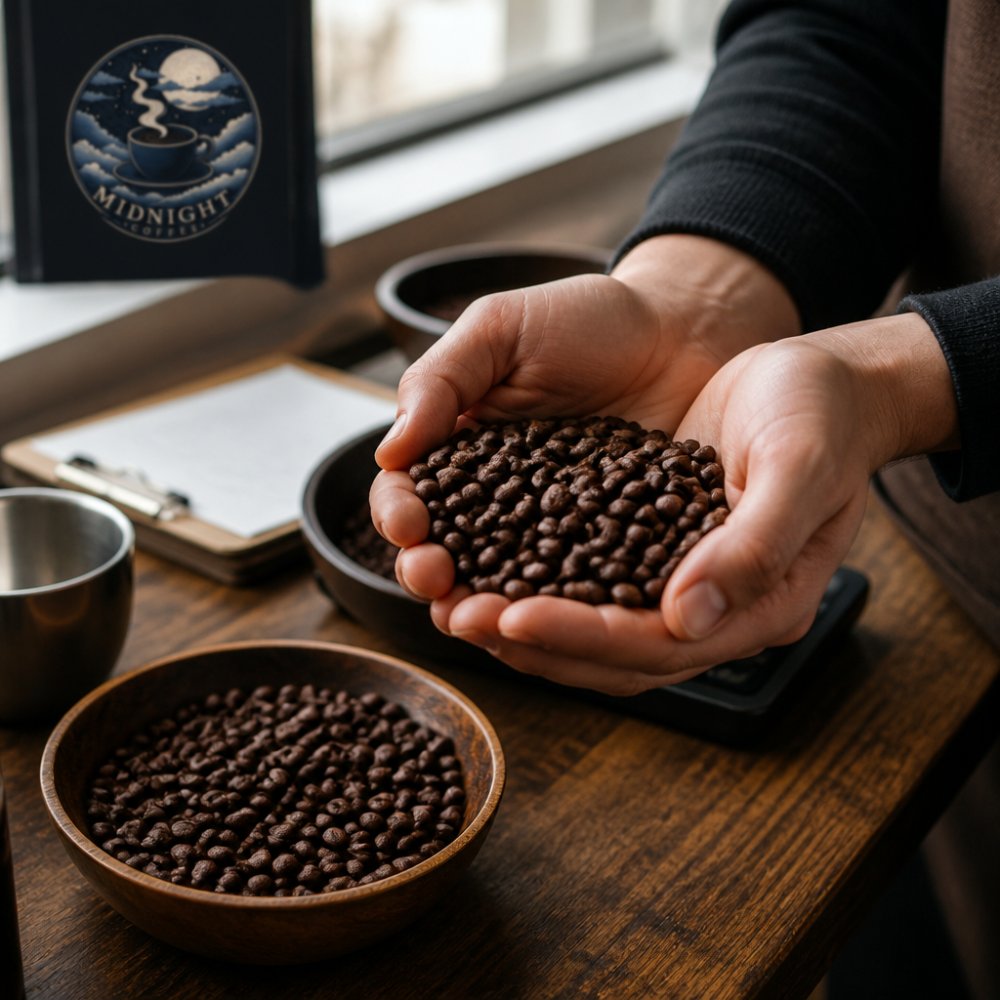
Freshly roasted beans have a dry, matte surface with a deep, even color. Darker roasts may show a slight sheen of oil, and that's normal for the roast level. What you don't want is a uniformly greasy, glossy surface on a medium roast, or beans that look faded and pale.
Look for consistency too. Fresh beans are plump and uniform. Old beans can look shriveled or dusty.
What Fresh Beans Smell Like
Smell is the fastest test. Open the bag and breathe in. Fresh beans release a bright, layered fragrance: chocolate, fruit, nuts, or floral notes depending on the roast.
Stale coffee smells flat. Some describe it as paper-like, musty, or faintly rancid. If you have to work to detect any aroma at all, the beans are past their prime.
One caveat: whole beans hold aroma far longer than ground coffee. Once ground, the surface area expands and flavor compounds escape fast.
How Long Do Coffee Beans Stay Fresh?
The timeline shifts with how you store them and whether the bag is opened:
| Storage Situation | Approximate Freshness Window |
|---|---|
| Whole beans, sealed bag, cool and dark | Two to four weeks |
| Whole beans, opened bag, airtight container | Two to three weeks |
| Ground coffee, opened | A few days to one week |
| Beans kept in the fridge or freezer door | Declines faster than cupboard storage |
Ground coffee loses freshness much faster than whole beans because more surface meets oxygen. If you can, grind right before brewing.
Signs Coffee Beans Have Gone Bad
Stale coffee announces itself in a few predictable ways. Watch for these signals:
- No aroma on opening. Fresh beans hit you with fragrance. Old beans barely register.
- A dull, matte, dusty look. Fresh color fades toward gray or pale brown.
- A musty or paper-like smell. This is the clearest sign of oxidation.
- Flat, muted flavor in the cup. The taste turns hollow and slightly bitter.
- No bloom when brewing. Fresh coffee releases carbon dioxide and puffs up when hot water hits it. Flat, still water means flat coffee.
A Simple At-Home Freshness Test
A single bloom test is a useful signal, but it is not a complete verdict. The most reliable at-home check combines four observable steps, label, nose, eye, and brew, so you are not relying on any one clue. Run them in order; each step takes under a minute, and together they give you a repeatable pass/fail read on any bag.
Step 1: Check the label (pass/fail)
- Pass: A printed roast date within the last two to four weeks.
- Fail: No roast date, or a date older than about two months. A best-before date alone does not count.
This is the only step that gives you a hard number. Everything after it is confirmation.
Step 2: Smell the beans (pass/fail)
- Pass: Open the bag and get a bright, layered hit of aroma, chocolate, fruit, nuts, or floral notes depending on the roast.
- Fail: Flat, paper-like, musty, or faintly rancid smell, or you have to work to detect anything at all.
Step 3: Look at the beans (pass/fail)
- Pass: Matte, even color; plump, uniform beans. A slight sheen is normal on dark roasts.
- Fail: Uniformly greasy or glossy surface on a medium roast, faded or pale color, or shriveled, dusty-looking beans.
Treat this as a supporting clue, not a standalone verdict, oiliness and color vary by roast level and processing (see the caveat below).
Step 4: Brew a small test cup (pass/fail)
- Put a spoonful of ground coffee in a small bowl or cup.
- Pour hot water just off the boil over the grounds.
- Watch the surface for ten to fifteen seconds.
- Pass: The grounds puff up and bubble as carbon dioxide escapes, this is the bloom.
- Fail: Flat, still grounds with little or no bubbling.
A livelier bloom generally means more gas is still trapped and the roast is fresher. Coffee roasting and degassing explained walks through why carbon dioxide release is such a reliable freshness signal.
Reading the results together
- Four passes: Fresh, brew with confidence.
- Label pass but smell or bloom fail: Likely past peak; use it up soon and expect a flatter cup.
- Label fail plus any other fail: Treat as stale; finish the bag or replace it.
- Any sign of moisture, mold, or a sour, off odor: Stop, this is spoilage, not staleness, and the bag should be discarded.
One caveat: roast level and processing change the clues
Do not treat any single visual or aroma sign as definitive. Darker roasts tend to show more surface oil and degas faster, so they can look "greasy" while still fresh and can go flat sooner. Natural-process beans often carry a heavier, fruitier aroma that lingers differently than washed beans. Light roasts may look dry and smell subtle even when fresh. That is why the four-step sequence, not any one test, is the reliable method.
How to Store Coffee Beans to Protect Freshness
Storage is where freshness is won or lost. Four enemies speed up staleness, oxygen, light, heat, and moisture, and the right container and location beat all four. But the practical question most people actually have is simpler: how long will this bag last where I keep it? The table below gives realistic quality windows by condition, separate from any expiration date.
Freshness timelines by storage condition
| Storage situation | Approximate quality window |
|---|---|
| Whole beans, unopened bag with one-way valve, cool and dark | Two to four weeks from roast date |
| Whole beans, opened bag, airtight opaque container, cool cupboard | Two to three weeks |
| Whole beans, opened bag left in the original bag, countertop | One to two weeks |
| Whole beans, refrigerator | Declines faster than cupboard storage; moisture and odor risk |
| Whole beans, freezer (airtight, full bag) | Extends quality for several weeks to a few months; use from frozen |
| Ground coffee, opened | A few days to one week |
Practical rules that make a real difference
- Use an opaque, airtight container, not the flimsy bag alone. A one-way valve helps gas escape without letting oxygen in, but only until you open the bag, after that, the valve is no longer protecting an unopened environment.
- Store in a cool cupboard, away from the stove, oven, and sunny counters.
- Skip the fridge. It introduces moisture and lets beans absorb odors from surrounding food.
- Freeze only what you will not open soon. Use an airtight, full bag to limit air, and scoop from frozen rather than thawing and refreezing.
- Buy whole beans and grind just before brewing. Ground coffee loses freshness far faster because more surface meets oxygen.
- Buy quantities you will finish within the quality window rather than stocking up.
Freshness versus food safety
For a full set of storage habits, our guide on how to keep coffee beans fresh covers seven rules that make a real difference, and our deeper walkthrough on how to store coffee beans is worth a read if you buy in larger bags.
Taste the Difference: Brew-Based Signs of Stale Beans
The cup itself is the final judge. Stale beans brew into a flat, muted coffee with a hollow middle and a dry finish. Fresh beans taste vibrant, with clear layers of flavor and a rounder body.
Espresso drinkers get an extra clue: crema. Fresh beans produce a thick, persistent crema because trapped gas creates those bubbles. Stale beans give a thin, quick-fading crema, or almost none.
Extraction changes too. Old coffee often runs fast through the brew and tastes watery, because the compounds that give body have already faded. If your usual recipe suddenly tastes weak, check the roast date before you blame your grinder.
Order Freshly Roasted Beans From Midnight Coffee
Our Cascades Blend makes an easy everyday cup, while Mountain Roast brings a richer, more comforting pour for mornings and afternoons.


You can browse the full coffee collection to find your next bag.
Frequently Asked Questions
How long do coffee beans stay fresh after roasting?
Whole coffee beans stay at their best for roughly two to four weeks after the roast date, with the peak freshness window often falling between four and fourteen days. After about four weeks, the aromatic compounds fade and the cup turns flatter, though the beans remain safe to brew. Ground coffee ages faster because more surface is exposed to oxygen. Buying in smaller amounts and keeping the bag sealed helps you stay inside that window.
Do fresh coffee beans have a strong smell?
Yes. Freshly roasted coffee beans release a clear, layered fragrance the moment you open the bag, and that aroma intensifies when you grind them. Beans that have lost their freshness smell muted, papery, or faintly musty, and the scent fades within seconds of opening the package. If you have to hold the bag close and search for a smell, the beans are likely past their peak.
Should fresh coffee beans look oily?
It depends on the roast level. Dark roasts often develop a glossy, oily surface within days of roasting because the beans release oils as they degas, and that sheen is normal. Lighter roasts usually stay matte. Oily beans are not automatically stale, but a sudden slick coating on beans that were previously dry, combined with a dull aroma, points to age rather than freshness.
Can you use coffee beans after their best-before date?
You can brew them, but expect a flatter cup. A best-before date is about quality, not food safety, so old beans will not make you sick. Signs coffee beans have gone bad in the quality sense include a papery or rancid smell, muted flavor, and thin crema. For the best results, check the roast date rather than the best-before date and store beans in an airtight container away from light and heat.
Fresh coffee is a habit, not a one-time purchase. The beans in your cupboard right now are quietly aging, and the difference between a vibrant cup and a flat one often comes down to how recently they were roasted. Let Midnight Coffee handle that part: freshly roasted, ethically sourced beans, delivered free to your door. Get started with Midnight Coffee and taste what a truly fresh roast does for your daily cup.
