

Table of Contents
- Why Decaf Cold Brew Deserves a Place in Your Routine
- What You Need: Decaf Beans, Water, and Basic Equipment
- The Decaf Cold Brew Coffee-to-Water Ratio That Works
- How Long to Steep Decaf Cold Brew for Smooth Flavor
- Step-by-Step: Combining Grounds, Water, and Time
- Making Decaf Cold Brew Concentrate for a Week of Coffee
- Does Decaf Cold Brew Have Caffeine? What to Expect
- Storing Your Decaf Cold Brew for Freshness and Safety
- Frequently Asked Questions
Last Updated: November 1, 2026
Why Decaf Cold Brew Deserves a Place in Your Routine
Learning how to make cold brew with decaf coffee starts with a long cold steep of decaffeinated beans, and it delivers the smooth, low-acid cup cold brew is known for without the caffeine jolt. Decaf does not have to taste like an afterthought. You get the ritual, the flavor, and the slow afternoon cup, just without the buzz.
Here is why it earns shelf space:
- Smoother flavor. Cold steeping is a popular way to get a mellow, less bitter cup.
- Flexible timing. Decaf lets you enjoy a cold brew in the evening with less caffeine to worry about.
- Easy to batch. One jar makes several servings for the week.
The 5-step method below takes about five minutes of hands-on work. The rest is patience.
What You Need: Decaf Beans, Water, and Basic Equipment
You need four things: decaf coffee beans, cold filtered water, a coarse grind, and a jar or pitcher. That is the whole list. No machine, no paper filters required if you use a fine-mesh strainer.
Here is the full setup:
- Decaf coffee: whole beans or pre-ground, about 100 g per 1 litre of water
- Water: filtered cold water, roughly 1 litre per batch
- Grinder: burr grinder if you have one, set to coarse
- Container: a 1-litre glass jar or pitcher with a lid
- Strainer: fine-mesh sieve, plus a paper coffee filter or cheesecloth
- Spoon: for stirring
If you want a decaf that fits the brew you are about to make, shop Cave Decaf. It is a decaf coffee built for evening cups and slow afternoons.

Choosing Whole Beans or Pre-Ground Coffee
Whole beans generally preserve more aroma than pre-ground coffee, so grinding them fresh is a good habit.
Buy whole beans when you can, and grind them right before you brew. If you are still deciding on a bag, see our guide on how to choose good decaf coffee.
Why Grind Size Matters for Cold Brew
Coarse grind is the rule for cold brew. Think sea salt, not sugar.
Too fine, and the grounds turn to sludge that clogs your filter and leaves grit in the cup. Too coarse, and the water passes over the grounds without pulling out much flavor. A coarse, even grind gives you a clean, full-flavored brew after a long steep.
A quick test: rub a pinch of grounds between your fingers. If it feels like coarse sand, you are close.
The Decaf Cold Brew Coffee-to-Water Ratio That Works
A common starting point for cold brew is roughly 1 part coffee to several parts water by weight, adjusted to taste.
Here is a simple reference table:
| Style | Coffee | Water | Dilute Before Serving? |
|---|---|---|---|
| Ready-to-drink | 100 g | 1 litre | No |
| Concentrate | 200 g | 1 litre | Yes, 1:1 or to taste |
| Small batch | 50 g | 500 ml | No |
Weigh your coffee if you have a kitchen scale. It is more consistent than scooping, and small changes in dose change the strength more than you would expect. For deeper ratio guidance, read our full coffee ratios breakdown.
Scale up in multiples of the same ratio. Doubling the batch means doubling both coffee and water, not just one.
How Long to Steep Decaf Cold Brew for Smooth Flavor
Steeping times vary, and cold brew is typically steeped for several hours up to about a day, depending on the strength you prefer. The variables that actually decide your cup are time, temperature, grind size, and how cleanly you separate the grounds from the liquid at the end.
Temperature and time both affect extraction: cooler steeping extracts more slowly, so it needs more time to reach the same strength.
Steeping time by style
- 12 hours (room temperature): light and tea-like, best if you plan to drink it black or over a lot of ice.
- 16 hours (room temperature): balanced, our default for a ready-to-drink batch.
- 20-24 hours (refrigerator): bold and slightly heavier, good for concentrate or for mixing with milk.
Set a timer or note the start time on the jar so you know when the batch is ready to strain.
Troubleshooting weak, bitter, or muddy decaf cold brew
If the finished brew is not right, adjust one variable at a time so you can tell what changed.
- Weak or watery: the grind was too coarse, the steep was too short, or the coffee-to-water ratio was too low. Grind slightly finer (still coarse overall), add 2-4 hours of steep time, or increase the dose by about 10-15% for the next batch.
- Bitter or harsh: the steep ran too long, the grind was too fine, or the water was too warm for too long. Shorten the steep by 2-4 hours, coarsen the grind, or move the jar to the fridge for the back half of the steep.
- Muddy or gritty: fine particles passed through the filter. Strain twice, once through a fine-mesh sieve, then through a paper coffee filter or a double layer of cheesecloth, and avoid pressing or squeezing the grounds, which pushes fines into the brew.
- Sour or flat: the brew sat too long after straining, or it was stored uncovered. Strain on schedule, seal the container, and drink within 5-7 days.
Step-by-Step: Combining Grounds, Water, and Time
Here is how to make cold brew with decaf coffee, start to finish. Steeping does most of the work.
- Weigh your beans. Measure 100 g of decaf beans for a 1-litre ready-to-drink batch, or 200 g for concentrate.
- Grind coarse. Set your grinder to the coarsest setting that still produces even grounds.
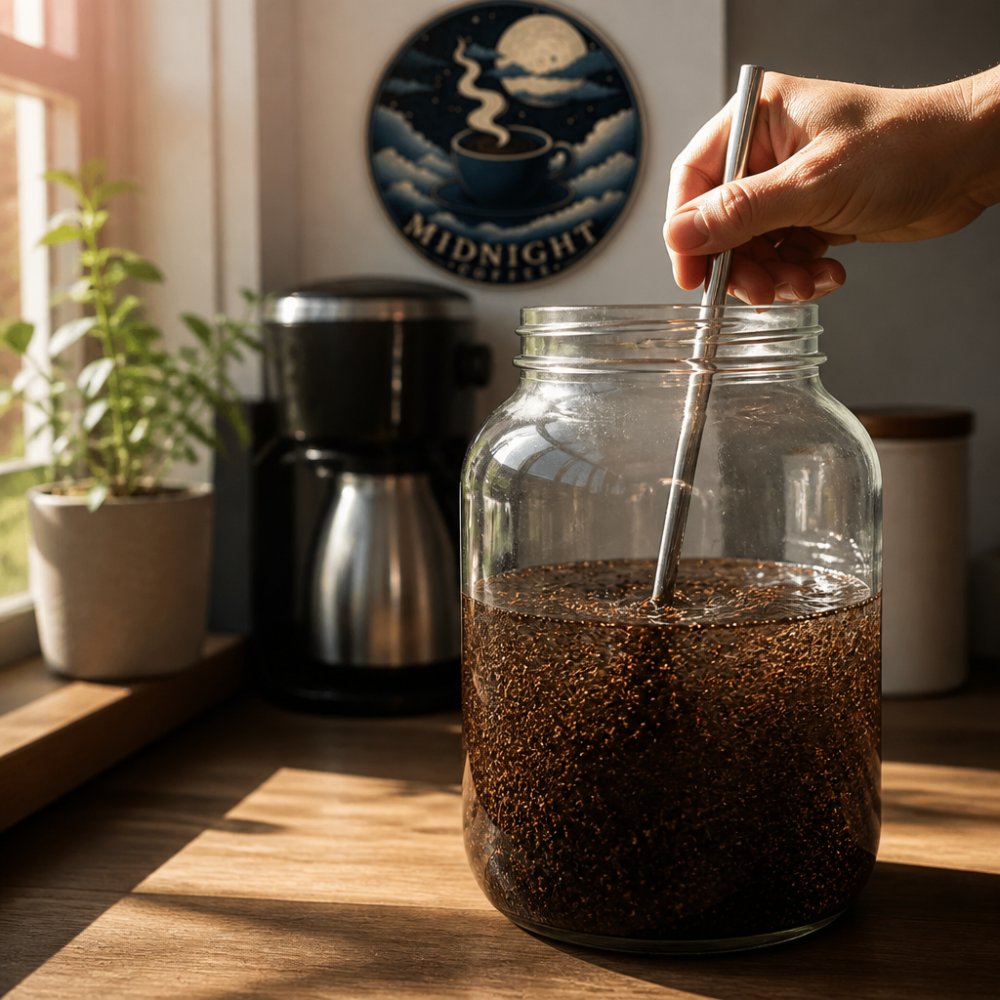
- Add grounds to the jar. Pour them into a clean 1-litre jar or pitcher.
- Pour cold water over the grounds. Use filtered water and pour slowly to wet all the grounds.
- Stir gently. About 10 seconds. Make sure no dry clumps sit on top.
- Cover and steep. Lid on, then leave it for 14 to 18 hours at room temperature or up to 24 hours in the fridge.
- Strain. Pour through a fine-mesh sieve lined with a paper filter or cheesecloth.
- Store and serve. Fridge the finished brew and serve over ice.
Straining and Filtering Your Brew
Straining is where grit gets in or stays out. Line a fine-mesh sieve with a paper coffee filter or a double layer of cheesecloth, then set it over a clean pitcher.
Pour slowly so the filter can catch the fine grounds.
Making Decaf Cold Brew Concentrate for a Week of Coffee
A decaf cold brew concentrate is a stronger batch you dilute to taste. Store the strained liquid in the fridge and mix it with water or milk when you want a cup.
Concentrate ratios and batch math
The 1:5 ratio is the anchor. From there, scale in multiples so you never have to guess:
| Batch | Decaf coffee (whole bean weight) | Cold filtered water | Approx. yield after straining |
|---|---|---|---|
| Small | 100 g | 500 ml | about 400-450 ml concentrate |
| Standard | 200 g | 1 litre | about 800-900 ml concentrate |
| Large | 400 g | 2 litres | about 1.6-1.8 litres concentrate |
Yield is lower than the water you start with because the grounds absorb liquid and some stays behind in the filter. Plan for roughly 80-90% of the water volume to end up as finished concentrate.
By volume, if you do not have a scale, 1 cup of coarse grounds to about 2½ cups of water is a workable approximation for concentrate, but weight is more consistent, especially when you scale up.
How to dilute concentrate
Dilution is personal, but these starting points cover most tastes:
- 1:1 concentrate to water: a balanced, ready-to-drink cold brew.
- 1:2 concentrate to water: lighter and more tea-like.
- 2:1 concentrate to water: strong, closer to an iced coffee base.
- With milk: start at 1:1 concentrate to milk, then adjust. Milk mutes both bitterness and brightness, so a slightly stronger concentrate often works better.
To serve, fill a glass with ice, pour in the concentrate, then add water or milk. Add ice last if you want to keep the dilution predictable, ice melts and quietly waters down the drink.
Storage and shelf life
- Keep concentrate in a sealed container in the refrigerator.
- Drink within 5-7 days for the best flavor; quality fades before safety becomes a concern.
- Leave it out at room temperature for no more than 2 hours (the WHO).
- Label the batch with the brew date so you are not guessing later in the week.
- A sour or off aroma means toss it, do not taste-test to confirm.
If you want a decaf that fits this brew, shop Cave Decaf from our roast lineup. It is built for evening cups and slow afternoons.
Does Decaf Cold Brew Have Caffeine? What to Expect
Decaf cold brew contains only a small amount of caffeine compared with regular cold brew.
What this means in practice:
- A cup of decaf cold brew is a low-caffeine drink, not a zero-caffeine one
- Serving size drives the total, so a large glass carries more than a small one
- If you are sensitive to caffeine late at night, treat decaf as "low," not "none"
For a fuller health-focused answer, read is decaf coffee bad for you. Cave Decaf is a decaf coffee option for evenings.
Storing Your Decaf Cold Brew for Freshness and Safety
Store decaf cold brew in a sealed container in the fridge and drink it promptly for the best flavor.
Follow these rules:
- Keep it covered. Air flattens the flavor fast.
- Keep it cold. Leave it out at room temperature for no more than 2 hours.
- Label the batch with the brew date.
- Smell before you drink. A sour or off aroma means toss it.
Watch out: leaving the grounds in the jar for days turns the brew bitter. Strain on schedule, then store only the liquid.
For bean storage, our guide on how to keep coffee beans fresh covers the basics. If you brew often, our Subscription Plans can help keep decaf beans on hand.
Frequently Asked Questions
Can cold brew be decaffeinated?
Yes. Cold brew can be made with decaffeinated coffee beans, and the process works exactly the same as with regular beans. You use coarse-ground decaf coffee and cold water, then let it steep for 12 to 18 hours before straining. The result is a smooth, low-caffeine cold brew concentrate you can dilute with water or milk.
Does decaf cold brew still contain caffeine?
Decaf cold brew does contain a small amount of caffeine, just not zero. Decaf cold brew contains far less caffeine than regular cold brew, so it is a lower-caffeine option.
How long should decaf coffee steep for cold brew?
Steeping times are a matter of taste, and steeping longer generally produces a stronger, more concentrated cup.
How should you store homemade decaf cold brew?
Store strained decaf cold brew in a sealed container in the refrigerator, and drink it promptly for the best flavor.
Making decaf cold brew at home comes down to three things: a coarse grind, the right ratio, and a steep you do not rush. Get those right, and the cup takes care of itself. Midnight Coffee roasts decaf beans fresh and ships them to your door, with ethically sourced lots and free delivery, so your next batch starts from better grounds. Shop Cave Decaf and keep the coffee ritual you love, any time of day.
